
The stock market is constantly changing. Prices of stocks move up and down every day based on economic conditions, investor behavior, company performance, and global events. These movements form what investors call market trends.
Understanding market trends is very important for anyone investing in the stock market. Whether you are a beginner or an experienced investor, analyzing trends can help you make better decisions about when to buy, hold, or sell stocks.
In this guide, we will explain what market trends are, why they matter, and how investors analyze them.
📊 What Are Market Trends?
A market trend refers to the general direction in which the stock market or a particular stock is moving over time.
Instead of focusing on short-term price changes, market trends help investors understand the overall direction of the market.
Stock markets such as the National Stock Exchange of India and BSE Limited often show trends that indicate whether the market is rising, falling, or moving sideways.
Recognizing these trends allows investors to make strategic investment decisions.
Lorem ipsum dolor sit amet, consectetur adipiscing elit. Ut elit tellus, luctus nec ullamcorper mattis, pulvinar dapibus leo.

📈 Types of Market Trends
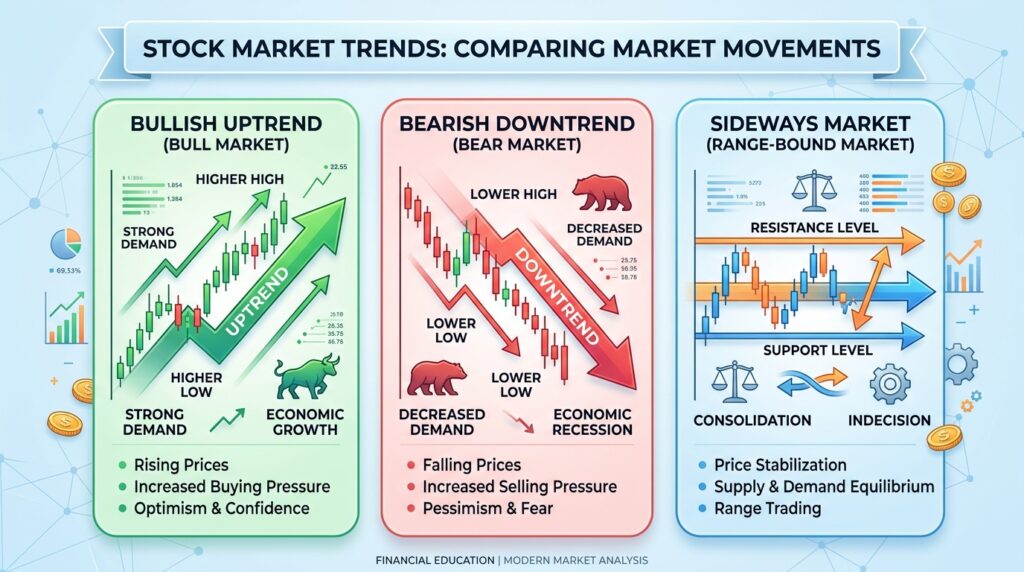
Market trends are generally classified into three main types.
1️⃣ Uptrend (Bullish Market)
An uptrend occurs when stock prices are consistently rising over a period of time.
Characteristics of an uptrend include:
Higher highs and higher lows in stock prices
Strong investor confidence
Increasing demand for stocks
During an uptrend, investors often look for opportunities to buy stocks and hold them for long-term growth.
2️⃣ Downtrend (Bearish Market)
A downtrend happens when stock prices continue to decline over time.
Signs of a downtrend include:
Lower highs and lower lows in price charts
Increased selling pressure
Negative market sentiment
In such conditions, investors may choose to avoid risky investments or sell certain stocks to protect their capital.
3️⃣ Sideways Trend (Range-Bound Market)
A sideways trend occurs when stock prices move within a limited range without a clear upward or downward direction.
This type of trend indicates:
Market uncertainty
Balanced buying and selling pressure
Limited price movement
Traders often look for short-term trading opportunities during sideways markets.
ipsum dolor sit amet, consectetur adipiscing elit. Ut elit tellus, luctus nec ullamcorper mattis, pulvinar dapibus leo.
🔍 Factors That Influence Market Trends
Many factors influence the direction of stock market trends. Understanding these factors can help investors analyze market behavior more effectively.
Some important factors include:
📊 Company earnings and financial performance
🌍 Global economic conditions
🏦 Interest rates and inflation
📉 Political or geopolitical events
👥 Investor sentiment and market psychology
All these elements can impact how the market behaves over time.

💻 How Investors Analyze Market Trends
Investors use various tools and techniques to study market trends and predict possible price movements.
Some commonly used methods include:
Technical analysis using stock charts
Trend lines and moving averages
Market indicators and trading volume analysis
Financial news and economic reports
Platforms such as TradingView and Moneycontrol help investors analyze stock charts and market data effectively.

🧠 Tips for Beginners to Understand Market Trends
If you are new to investing, these tips can help you understand market trends better:
Follow stock market news regularly
Study price charts before investing
Avoid making decisions based on short-term fluctuations
Focus on long-term market direction
Keep learning about market indicators and analysis tools
Understanding trends takes time and practice, but it greatly improves investment decisions.
🚀 Final Thoughts
Market trends play a crucial role in stock market investing. By identifying whether the market is in an uptrend, downtrend, or sideways movement, investors can plan their strategies more effectively.
Instead of reacting emotionally to short-term price changes, successful investors focus on analyzing trends, studying market data, and making informed decisions.
With patience, research, and continuous learning, understanding market trends can become a powerful tool for achieving long-term success in the stock market. 📈